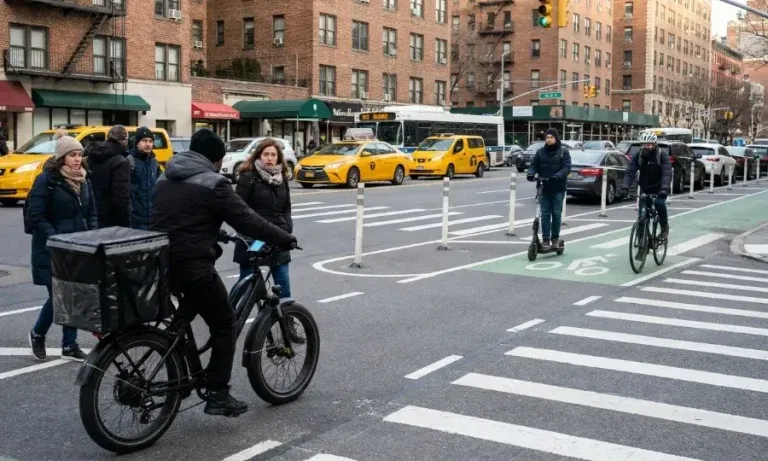

Riding a bicycle down a bustling New York City avenue requires sharp focus and quick reflexes. Even the most careful riders face sudden hazards. An opened car door into moving traffic presents one of the most frightening dangers on city streets. As an experienced NYC personal injury lawyer, our legal team routinely represents injured cyclists who suffered severe harm because a driver or passenger failed to check their mirrors. These crashes, commonly called dooring accidents, lead to painful orthopedic trauma, concussions, and steep medical bills. Fortunately, New York traffic statutes protect riders when negligent vehicle occupants cause these sudden collisions.
Key Takeaways
- New York Vehicle and Traffic Law Section 1214 creates an affirmative duty on drivers and passengers regarding door opening, and courts may treat violations as negligence per se when the elements of that doctrine are satisfied.
- Under New York Vehicle and Traffic Law Section 388(1), vehicle owners and commercial auto policies face vicarious liability when passengers negligently open doors into oncoming traffic.
- Appellate courts recognize that opening a car door into moving traffic can constitute the sole proximate cause of an accident, but no primary source documents the specific $2,500,000 settlement figure.
Many injured cyclists wonder how fault affects their insurance claims. Under New York Vehicle and Traffic Law (NY VTL) Section 1214, no person may open a motor vehicle door on the side available to moving traffic unless it is reasonably safe to do so. Also, the rule strictly forbids leaving a door open longer than necessary to load or unload passengers. Consequently, this state statute places an affirmative legal duty directly upon motorists and passengers rather than oncoming cyclists. When a driver violates this rule, the legal standing shifts heavily in favor of the injured bicyclist.
Understanding Negligence Per Se in New York Dooring Cases
Establishing fault forms the bedrock of every personal injury claim. In standard car accident litigation, the injured party must prove that the driver acted carelessly under general common-law principles. However, dooring crashes follow a far more potent legal doctrine. Under New York law, a demonstrated violation of NY VTL Section 1214 can constitute negligence per se when the elements of that doctrine are satisfied. Negligence per se means that violating an enacted safety statute conclusively establishes negligent conduct as a matter of law. Therefore, the court recognizes the violation itself as definitive proof of careless behavior.
This statutory standard gives our NYC personal injury attorneys immense leverage during settlement talks. Rather than debating whether the driver exercised reasonable caution, the legal dispute centers on whether the door opened into moving traffic. Once we secure police reports, witness testimony, or surveillance camera footage proving the door swung open directly into your path, liability becomes virtually indisputable. Insurance adjusters understand the power of negligence per se. Consequently, this clear finding eliminates many typical defense arguments and forces insurers to evaluate claims seriously early in the process.
Municipal Regulations and Rider Protections in New York City
State statutory law is not the only framework protecting cyclists across the five boroughs. In addition to state statutes, local municipal codes govern street activity. Municipal regulations further reinforce this standard under Rules of the City of New York Title 34 Section 4-12(c). This city regulation explicitly bars vehicle occupants from opening doors on the side of moving traffic whenever doing so interferes with oncoming bicycles or vehicles. In addition, the rule mandates that drivers must yield to all moving street traffic before cracking open a door.
These dual layers of protection apply across all boroughs. For example, whether you ride past double-parked vehicles along Queens Boulevard or commute through protected bike lanes in Midtown Manhattan, these traffic rules shield you. Local laws treat bicycles as legitimate moving traffic. Therefore, drivers cannot dismiss a rider by claiming they expected only full-sized automobiles. When commercial delivery vans or rideshare vehicles pull to the curb and discharge passengers haphazardly, they violate both state and city traffic mandates.
Appellate Precedent and the Sole Proximate Cause Standard
Insurance defense adjusters often attempt to blame the bicyclist to diminish settlement payouts. They may allege that the rider traveled too fast, failed to swerve, or rode too close to parked cars. However, New York appellate courts have repeatedly rejected these blame-shifting tactics in dooring crashes. Appellate courts have affirmed that violating NY VTL Section 1214 can constitute the sole proximate cause of a collision, as demonstrated by the Appellate Division, Second Department in Montesinos v. Cote in December 2007. In that ruling, the appellate court affirmed summary judgment on liability against the driver who swung open their door into traffic.
Securing summary judgment on liability means the trial judge rules on fault before the case ever reaches a jury. As a result, the jury only decides the financial compensation owed for your pain, suffering, and financial losses. Eliminating liability defenses creates immense financial pressure on insurance companies. When an insurer faces a trial focused purely on graphic injuries and medical expenses without any defense on fault, their financial exposure rises rapidly. Therefore, skilled Brooklyn bicycle crash lawyers use this appellate precedent to command higher pre-trial settlements.
Passenger Actions and Vicarious Vehicle Owner Liability
Many devastating dooring accidents involve taxi, rideshare, or limousine passengers exiting onto busy roadways. Injured cyclists often worry about recovering damages when an uninsured or underinsured passenger opens the door. Fortunately, New York insurance law provides broad financial protections for injured victims. Under New York Vehicle and Traffic Law Section 388(1), vehicle owners face vicarious liability for crashes caused by passengers opening doors into traffic, as affirmed by the Appellate Division, Second Department in Cohn v. Nationwide Mutual Insurance Company in October 2001.
This critical legal principle means the owner’s primary auto insurance policy must provide coverage for the passenger’s negligent act. For instance, if an Uber, Lyft, or yellow cab passenger throws open a door into a bike path, the commercial vehicle policy covers the resulting damages. These commercial policies frequently carry substantial bodily injury limits. Also, corporate entities and commercial fleet owners possess significant commercial umbrella coverage. Our Queens car accident attorneys routinely identify every applicable insurance policy to maximize financial recovery for injured clients.
How Clear Liability Drives Higher Pre-Trial Settlement Offers
Insurance companies evaluate personal injury claims using a basic mathematical assessment of risk. When liability is uncertain, adjusters aggressively discount settlement offers, betting that a jury might assign comparative negligence to the injured cyclist. However, uncontroverted statutory liability under NY VTL Section 1214 fundamentally alters that risk calculation. When the defense cannot escape liability, the claim value reflects the full extent of physical and emotional damages. Clear proof of liability coupled with severe orthopedic injuries elevates pre-trial valuations significantly.
These real-world outcomes prove that firm statutory liability secures exceptional financial recoveries across every severity level.
Common Injuries in NYC Bicycle Dooring Crashes
Dooring crashes rarely cause minor scrapes because the human body absorbs massive kinetic energy upon impact. A cyclist traveling at moderate speed has virtually zero time to brake when a car door suddenly swings outward. Consequently, riders often experience a severe primary collision with the metal frame of the door, followed by a violent secondary impact with the asphalt. Many cyclists sustain serious orthopedic trauma, including broken clavicles, fractured wrists, and shattered pelvic bones.
Plus, the secondary impact frequently produces catastrophic head and spinal injuries. Even while wearing certified helmets, cyclists suffer traumatic brain injuries, concussions, and severe facial lacerations. Herniated cervical and lumbar discs often compress spinal nerve roots, causing radiating pain and physical disability that requires epidural injections or spinal fusion surgery. Documenting these debilitating injuries through prompt diagnostic MRI scans and objective specialist evaluations ensures insurance companies compensate every physical and emotional injury thoroughly.
Overcoming the Comparative Fault Defense in Bike Lane Collisions
New York operates under a pure comparative negligence system under Civil Practice Law and Rules (CPLR) Article 14-A. Under this law, an insurance adjuster will routinely argue that you share partial blame for your injuries. They might argue you should have spotted the vehicle or steered away faster. Nevertheless, experienced NYC personal injury lawyers refute these bad-faith claims by pointing directly to physical roadway designs and driver duties. Under New York law, cyclists have preferential use of designated bike lanes, and motorists must yield when crossing or turning across them, but cyclists do not possess an absolute right of way merely by being in a bike lane.
Also, human reaction times make evading a door that opens within a split second physically impossible. In dense traffic along avenues in Manhattan or Brooklyn, swerving out of a bike lane into moving automotive traffic poses fatal risks. Therefore, continuing straight remains the only instinctive response for many riders. Our attorneys use accident reconstruction specialists, frame-by-frame traffic camera video, and vehicle event data recorders to demonstrate that our clients had neither the warning nor the physical distance to avoid the impact.
Essential Steps to Take Immediately Following a NYC Dooring Collision
The actions you take immediately following a bicycle accident significantly influence your physical recovery and the financial outcome of your legal claim. First, call 911 immediately and demand that the police respond to the scene. NY VTL Section 1214 governs dooring violations, but there is no official requirement that NYPD officers must document the violation in any specific manner in police accident reports. Next, seek prompt emergency medical attention, even if adrenaline temporarily masks your pain. Certain traumatic injuries, such as internal bleeding or micro-concussions, require prompt medical diagnosis.
In addition, preserve all perishable evidence before departing the scene or as soon as your physical condition stabilizes. Capture clear photographs and videos of the opened vehicle door, the resting position of your bicycle, any damaged equipment, and surrounding street signs. Secure contact information from any bystanders, shopkeepers, or delivery workers who witnessed the incident. Finally, retain your damaged bicycle, cracked helmet, and torn riding gear without repairing or altering them. Physical evidence serves as irrefutable proof against defense claims in a court of law.
Pursuing Justice with a Trusted NYC Personal Injury Lawyer
Recovering from a severe dooring collision requires substantial time, dedicated medical care, and strong financial support. While you focus on healing, insurance companies deploy teams of claims adjusters and defense lawyers to protect their corporate profits. You do not have to confront these deep-pocketed corporate insurers alone. As seasoned New York trial attorneys, our firm stands up for injured cyclists across Manhattan, Brooklyn, Queens, the Bronx, and Staten Island.
We investigate the crash scene thoroughly, pull vital traffic camera footage, identify all applicable commercial insurance policies, and build an airtight case based on statutory negligence. If an opened vehicle door injured you or someone you love, contact our dedicated legal team today. Schedule a free, confidential case evaluation with an accomplished NYC personal injury lawyer to protect your rights, assert statutory liability, and recover the compensation you rightfully deserve.
Sources
- FindLaw, New York Consolidated Laws, Vehicle and Traffic Law - VAT § 1214 Opening and closing vehicle doors
This article was drafted with AI assistance. Please verify all claims and information for accuracy. The content is for informational purposes only and does not constitute professional advice.
Free Case Consultation
Injured in an accident? Speak directly with an experienced NYC personal injury attorney at
Rosenberg, Minc, Falkoff & Wolff.
Your consultation is free, confidential, and risk-free.
No obligation - No upfront fees - You don't pay unless we win
Follow RMFW Law for legal insights and case results:
Gary Silverstein
Gary Silverstein has been a partner of Rosenberg, Minc, Falkoff & Wolff since 2001, and an associate of the firm since 1989. Mr. Silverstein graduated with a Bachelor of Science degree from State University of New York College at Oneonta in 1983. Mr. Silverstein holds a degree of Juris Doctor from the University of Miami School of Law, having graduated in 1988.