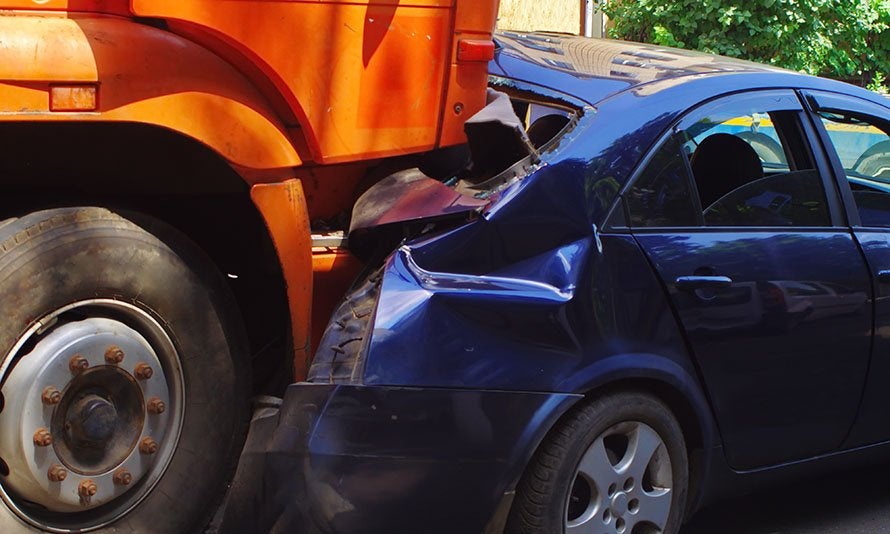
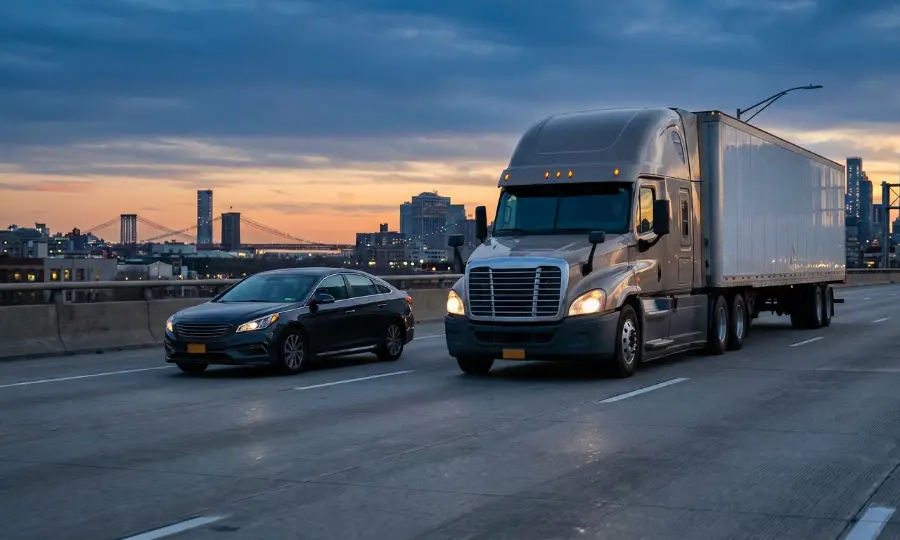
A collision with a commercial vehicle on a crowded New York road changes lives in an instant. The immense weight of commercial trucks creates devastating impacts, leaving injured drivers and passengers facing catastrophic injuries, mounting medical bills, and lost wages. In these complex cases, understanding liability rules is essential for protecting your legal rights.
Key Takeaways
- Under CPLR § 1411(b), enacted on May 26, 2026, plaintiffs in New York motor vehicle collisions are barred from financial recovery if assigned 51 percent or more of the fault.
- Plaintiffs assigned 50 percent or less of the fault retain proportional recovery under CPLR § 1411(b) for Article 51 motor vehicle cases only, with damages reduced by their allocated percentage of blame.
- The 2026 budget reform amended Insurance Law § 5102(d) to eliminate the 90/180-day category, requiring objective proof for serious injury threshold qualification.
- Pure comparative negligence remains intact under CPLR § 1411(a) for non-auto personal injury, property damage, and wrongful death claims.
On May 26, 2026, Governor Kathy Hochul enacted Part EE of New York’s FY 2027 Budget legislation (S9008-C / A10008-C), introducing statutory motor vehicle tort reform that applies to actions commenced on or after enactment, as documented by legal analysts at Wilson Elser. This legislation fundamentally altered how New York courts resolve fault and compensation in commercial collision lawsuits. This guide covers how these major statutory updates impact your rights, who is affected, and the exact steps needed to protect your financial recovery.
Understanding the Transition from Pure Comparative Negligence
For decades, New York operated under a pure comparative fault system. Under this older framework, injured plaintiffs could recover financial damages regardless of their assigned share of blame, even if they were 90 percent responsible for a crash. The court simply reduced their monetary recovery by their percentage of culpability.
The 2026 reform amended New York Civil Practice Law and Rules (CPLR) § 1411 by adding subsection (b). According to NYS Senate Open Legislation for CPLR § 1411(b), this amendment carves out motor vehicle personal injury actions governed by Insurance Law Article 51 from the state’s traditional pure comparative fault framework.
As a top NYC personal injury lawyer, our firm regularly guides injured motorists through these shifting legal standards. Understanding how fault allocation now works is critical when pursuing claims against large trucking corporations and commercial delivery fleets.
The Modified Comparative Fault Threshold for Motor Vehicle Claims
Under newly added CPLR § 1411(b), New York established a modified comparative fault standard for motor vehicle personal injury actions. As detailed in legal analysis by Wilson Elser, a plaintiff in a commercial collision or auto claim is completely barred from recovery if their culpable conduct is greater than the culpable conduct of the defendant or the combined culpable conduct of multiple defendants.
In practice, this creates a 51 percent fault bar threshold. If an injured motorist is assigned 51 percent or more of the responsibility for a crash involving a commercial truck, that motorist may recover zero compensation for personal injuries.
Conversely, for plaintiffs assigned 50 percent or less of the fault in a commercial vehicle collision, financial recovery remains proportional under CPLR § 1411(b) for Article 51 motor vehicle cases only. As noted in an analysis by the Law Office of Jason Tenenbaum, the court reduces the total recoverable damages strictly by the plaintiff’s allocated percentage of culpable conduct.
Example of the 51 Percent Fault Bar in a Commercial Collision
Consider a scenario where an SUV collides with a commercial tractor-trailer making an improper turn on the Brooklyn-Queens Expressway. If a jury awards $1,000,000 in total damages but assigns 40 percent fault to the SUV driver and 60 percent fault to the truck driver, the plaintiff recovers $600,000. However, if the jury assigns 51 percent fault to the SUV driver for speeding, the plaintiff recovers nothing under CPLR § 1411(b).
Where Pure Comparative Negligence Still Applies
While motor vehicle personal injury claims now follow the modified 51 percent bar, the 2026 reforms did not eliminate pure comparative negligence entirely. Outside the Article 51 motor vehicle carveout, New York maintains pure comparative negligence for general non-auto personal injury, property damage, and wrongful death claims, according to NYS Senate Open Legislation for CPLR § 1411(a).
Consequently, if an accident causes both severe bodily injury and total destruction of a vehicle, two separate legal standards may apply during settlement discussions:
- Personal Injury Claims: Governed by the 51 percent modified comparative fault bar under CPLR § 1411(b).
- Property Damage Claims: Governed by traditional pure comparative negligence under CPLR § 1411(a), allowing recovery reduced strictly by percentage of fault.
- Wrongful Death Claims: Evaluated under traditional proportional comparative fault rules outside the Article 51 bodily injury restriction.
Updates to the Serious Injury Threshold Under Insurance Law § 5102(d)
New York is a no-fault auto insurance state, requiring injured motorists to satisfy the statutory serious injury threshold before seeking non-economic damages for pain and suffering. The 2026 budget reform enacted significant changes to state tax thresholds, not NYC TLC thresholds.
Specifically, the 2026 reform amended Insurance Law § 5102(d) to eliminate the 90/180-day non-permanent category from the serious injury threshold, restricting soft-tissue injury claims in motor vehicle and trucking litigation, as reported by Wilson Elser. Claimants can no longer qualify for third-party lawsuits solely by showing that a temporary impairment prevented them from performing daily activities for 90 out of the first 180 days following a collision.
To pursue compensation from an at-fault commercial trucking carrier, injured claimants must now present objective medical proof satisfying remaining statutory categories, such as fractures, permanent consequential limitations, or significant disfigurement.
Statutory Caps on Non-Economic Damages Under Insurance Law § 5104(d)
The 2026 legislation also enacted strict limitations regarding certain driver behaviors. Part EE added Insurance Law § 5104(d), capping non-economic damages at $100,000 for at-fault injured claimants who were operating an uninsured vehicle, driving while impaired, or committing a felony at the time of the collision, as outlined in New York Department of Financial Services Insurance Circular Letter No. 3.
Commercial trucking insurers and their defense attorneys aggressively investigate whether any of these statutory exclusions apply to reduce their overall payout exposure.
Procedural Changes to Trial Structures and Pre-Judgment Interest
In addition to substantive liability shifts, the 2026 reform introduced crucial procedural modifications for civil litigation. Procedurally, trial structures for motor vehicle collisions must now determine liability and the serious injury threshold prior to the calculation of damages, halting pre-judgment interest accrual until both fault and serious injury findings are made, according to legal commentary from Segal McCambridge Singer & Mahoney.
Because commercial trucking defense teams frequently employ aggressive tactics to assign shared liability above the 50 percent threshold, establishing definitive liability early through accident reconstruction, electronic logging device data, and dashcam footage is more important than ever.
Frequently Asked Questions
How does the 2026 New York comparative fault law affect commercial truck accident claims?
Under CPLR § 1411(b), an injured driver cannot recover non-economic damages in a motor vehicle personal injury lawsuit if they are assigned 51 percent or more of the fault, though PIP benefits remain available. If their share of fault is 50 percent or lower, their monetary recovery is reduced proportionally by their percentage of culpability.
Can I still file a claim if I was partially at fault for a truck collision?
Yes. As long as your fault does not exceed 50 percent, you are legally entitled to recover damages. For example, if you are assigned 25 percent fault and your damages equal $400,000, you can recover $300,000 from the at-fault commercial vehicle operator.
What happened to the 90/180-day serious injury rule in New York?
The 2026 budget legislation enacted by Governor Kathy Hochul removed the 90/180-day non-permanent category from Insurance Law § 5102(d). Motorists injured in truck collisions must now prove serious injury using remaining categories, such as fractures, disfigurement, or permanent functional limitations.
Does the new 51 percent bar apply to property damage claims?
No. Under CPLR § 1411(a), pure comparative negligence still governs property damage and wrongful death claims. A motorist who is 60 percent at fault can still recover 40 percent of their vehicle repair or replacement costs from the other driver.
Next Steps After a Commercial Truck Collision in New York
Navigating commercial vehicle litigation requires decisive action, thorough evidence gathering, and experienced advocacy under New York’s updated statutory framework. If you or a loved one has suffered injuries in a commercial truck collision, take these essential steps immediately:
- Seek Comprehensive Medical Evaluation: Document all physical injuries with objective diagnostic tests such as MRIs, CT scans, and X-rays to establish the serious injury threshold under Insurance Law § 5102(d).
- Preserve Electronic and Physical Evidence: Request the preservation of commercial truck black box data, electronic logging devices (ELD), dashcam footage, and maintenance logs before routine deletion cycles occur.
- Avoid Providing Recorded Statements: Do not provide recorded interviews or statements to commercial insurance adjusters without legal representation, as their primary goal is shifting fault above the 50 percent threshold.
- Consult an Experienced Legal Advocate: Partner with a dedicated attorney who understands how to counter defense fault-allocation strategies and build an undeniable case for full compensation.
Sources
- New York State Senate, Civil Practice Law and Rules Section 1411 - Damages Recoverable for Contributory Negligence or Assumption of Risk
- New York State Department of Financial Services, Insurance Circular Letter No. 3 (2026): Statutory Amendments to Insurance Law Article 51
This article was drafted with AI assistance. Please verify all claims and information for accuracy. The content is for informational purposes only and does not constitute professional advice.
Free Case Consultation
Injured in an accident? Speak directly with an experienced NYC personal injury attorney at
Rosenberg, Minc, Falkoff & Wolff.
Your consultation is free, confidential, and risk-free.
No obligation - No upfront fees - You don't pay unless we win
Follow RMFW Law for legal insights and case results:
Gary Silverstein
Gary Silverstein has been a partner of Rosenberg, Minc, Falkoff & Wolff since 2001, and an associate of the firm since 1989. Mr. Silverstein graduated with a Bachelor of Science degree from State University of New York College at Oneonta in 1983. Mr. Silverstein holds a degree of Juris Doctor from the University of Miami School of Law, having graduated in 1988.